Q1. Why is the density of the nucleus more than that of the atom? Show that the density of nuclear matter is same for all nuclei.
Q2. Write a short note on the discovery of neutron.
Q3. What are the properties of a neutron?
Q4. What are nuclear forces? Write their properties.
Q5. For greater stability a nucleus should have greater value of binding energy per nucleon. Why?
Q9. Define half life period and decay constant for a radioactive substance. Deduce the relation between them.
Q10. Define average life of a radioactive substance. Obtain the relation between decay constant and average life.
Q11. Deduce the relation between half life and average life of a radioactive substance.
Q12. What is nuclear fission? Give an example to illustrate it.
Q13. What is nuclear fusion? Write the conditions for nuclear fusion to occur.
Q14. Distinguish between nuclear fission and nuclear fusion.
Q15. Explain the terms 'chain reaction' and 'multiplication factor. How is a chain reaction sustained?
Q1. What is radioactivity? State the law of radioactive decay. Show that radioactive decay is exponential in nature
Answer
Ans. Radioactivity: The disintegration of nucleus instantly into $\alpha, \beta, \gama$, ẞ, yrays is known as radio activity. Radioactive decay Law: According to this law the rate of radioactive decay of atoms()at any instant is directly proportional to the number of atorms(N) present at that instant.
Radioactive decay is exponential in nature: Let N be number of nuclei present in a radioactive substance and No be the number of radioactive nuclei at to, then,
dNaN
dt dN =-AN (X = decay constant) dt dN=-2.Ndt dN=-Adt(1) N
On integrating equation 1 we get, No = dt N InN - λ (1-10) No
On substituting too in the above equation, InN = -λι No N=Noe
This equation indicates that radioactive decay is exponential in nature.
Q1. Explain the principle and working of a nuclear reactor with the help of a labelled diagram.
Answer
Ans. Principle of nuclear reactor: Nuclear reactor works on the. principle of achieving controlled chain reaction,.
- Fuel: Fissionable material, commonly Uranium isotopes are used.
- Moderator: The purpose of moderator is to slow down the fast moving neutrons. Eg: Heavy water, Graphite
- Control rods: To control the chain reaction. Eg: Cadmium (or) Boron rods
- Coolant:The substance used to absorb heat generated in the reactor
- Radiation shielding: Lead blocks and concrete walls of thickness. $10m$ areused for the reactor. Turbines
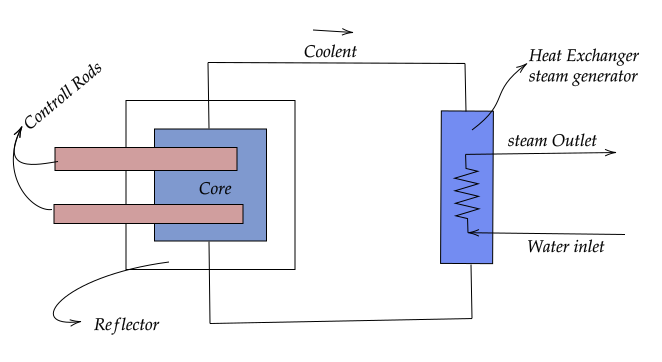
Working:- Nuclear reactor works on the principle of controlled and sustained chain reaction and releases large amount of energy
Q2. Explain the source of stellar energy. Explain the carbon - nitrogen cycle, proton-proton cycle occurring in stars
Answer
Ans.
The source of stellar energy is nuclear fusion reaction, for which hydrogen is the fuel.
Energy from Sun and Stars : Sun and Stars have been radiating huge amounts of energy by nuclear fusion reactions taking place in their core, where the temperature is of the order 107 K. More scientists proposed two types of cyclic processes for the source of energy in the Sun & Stars. They are
Carbon - Nitrogen Cycle : Carbon - Nitrogen cycle is one of the most important nuclear reactions for the production of solar energy by fusion.
$$\begin{gathered}
{}_{6}^{12}C\:+{}_{1}^{1}H\:\rightarrow\:N\:+\:\gamma \\
_{7}^{13}N\:\rightarrow\:{}_{6}^{12}C\:\:+\:e^{+}\:+\:\nu \\
\begin{aligned}&{}_{6}^{13}C\:+{}_{1}^{1}H\:\to\:{}_{7}^{14}N\:\:+\:\nu\\&{}_{7}^{14}N\:+{}_{1}^{1}H\:\to\:_{8}^{15}O\:+\:\gamma\end{aligned} \\
_{8}^{15}O\:\rightarrow\:{}_{7}^{15}N\:+\:e^{+}\:+\:\nu \\
{}_{7}^{15}N\:+{}_{1}^{1}H\:\rightarrow\:{}_{6}^{12}C\:+\:{}_{2}^{4}He\:+ \:\gamma
\end{gathered}$$
The entire cycle can be summed up as, $4_{1}^{1}H\to{}{}{}{}_{2}^{4}He+2e^{+}+3\nu+3\gamma$
The energy released during this process is $26.70\:\: MeV$
Proton - Proton Cycle : At higher temperature the thermal energy of the protons is sufficient to form a deuteron and a positron. The deuteron then combines with another proton to form higher nuclei of helium ${}_2^3He$ Two such helium nuclei combine with another proton releasing a total amount of energy 25.71 MeV. The nuclear fusion reactions are given below ..
$$\begin{array}{c} \\{{_2^4He\:+\:H\:\to\:H\:+\:e^{+}\:+\:\nu}}\\{{_1^2H\:+\:_1^1H\:\to\:He\:+\:\gamma}}\\{{_1^2H\:+\:_1^1H\:\to\:He\:+\:\gamma}}\end{array}$$
For this equation to takes place first three equations must occur twice.
$$_2^3He+_2^3He\to_2^4He\:+\:2_1^1H$$
The net result of the above reactions is $4_{1}^{1}H\to{}{}{}{}{}^{4}He+{}{}2e^{+}+{}2v+{}2\gamma$
The energy released during this process is $26.70\:\: MeV$
Q3. Define mass defect and binding energy. How does binding energy per nucleon vary with mass number? What is its significance?
Q4. What is radioactivity? State the law of radioactive decay. Show that radioactive decay is exponential in nature.
Q1. Show that the density of a nucleus does not depend upon its mass number (density is independent of mass)
Q2. Compare the radii of the nuclei of mass numbers 27 and 64 (Ans: 3:4)
Q3. The radius of the oxygen nucleus O is 2.8x10m. Find the radius of lead nucleus 20Pb
Q4. Find the binding energy of Fe. Atomic mass of Fe is 55.9349u and that of Hydrogen is 1.00783u and mass of neutron is 1.00876u 5.
Q5. How much energy is required to separate the typical middle mass nucleus 120Sn into its constituent nucleons? (Mass of 120 Sn=119.902199u, mass of proton-1.007825u and mass of neutron =1.008665u)
Q6. Calculate the binding energy of an a-particle. Given that mass of proton =1.0073 u, mass of neutron = 1.0087u. and mass of a particle = 4.0015u.
Q7. Find the energy required to split 160 nucleus into four a particles. The mass of an a- particle is 4.002603u and that of oxygen is 15.994915u. (Ans: 14.43Mev)
Q8. Calculate the binding energy per nucleon of 5,CI nucleus. Given that mass of CI nucleus = 34.98000 u. mass of proton = 1.007825u mass of neutron-1.008665 u and 1 is equivalent to 931 MeV. (Ans: 8.219 MeV)
Q9. Calculate the binding energy per nucleon of Ca. Given that mass of Ca nucleus = 39.962589 u, mass of a proton = 1.007825 u.: mass of Neutron = d1.008665 u and 1 u is equivalent to 931 Mev.
Q10. Calculate (1) mass defect, (ii) binding energy and (iii) the binding energy per nucleon of C nucleus. Nuclear mass of C = 12.000000 u; mass of proton = 1.007825 u and mass of neutron = 1.008665 u.
Q11. The binding energies per nucleon for deuterium and helium are 1.1 MeV and 7.0 MeV respectively. What energy in joules will be liberated when 10v deuterons take part in the reaction.
Q12. Bombardment of lithium with protons gives rise to the following reaction: Li+H? 2Hel+9. Fine the 9-value of the reaction. The atomic masses of lithium, proton and helium are 7.016u. 1.008u and 4.004u respectively.
Q13. The half life radium is 1600 years. How much time does 1 g of radium take to reduce to 0.125g (Ans:4800 years)
Q14. Plutonium decays with a half-life of 24.000 years. If plutonium is stored for 72,000 years, what fraction of it remains?
Q15. A certain substance decays to 1/232 of its initial activity in 25 days. Calculate its half-life.
Q16. 16. The half-life period of a radioactive substance is 20 days. What is the time
Q17. taken for 7/8th of its original mass to disintegrate? (Ans:60 days)
Q18. How many disintegrations per second will Occur in one gram of U. if its half-life against a-decay is 1.42x10¹7s? (Ans:1.235x10t disintegrations/ second)
Q19. The half-life of a radioactive substance is 100 years. Calculate in how many years the activity will decay to 1/0th of its initial value.
Q20. One gram of radium is reduced by 2 milligram in 5 years by á-decay. Calculate the half-life of radium.
Q21. The half-life of a radioactive substance is 5000 years. In how many years.its activity will decay to 0.2 times of its initial value? Given log, 5 =0.6990. (Ans: 1.165x10¹ years)
Q22. An explosion of atomic bomb releases an energy of 7.6 x 10¹⁹ J. If 200 Mev energy is released on fission of one U atom calculate (1) the number of uranium atoms undergoing fission, (ii) the mass of uranium used in the bomb.
Q23. If one microgram of U is completely destroyed in an atom bomb, how much energy will be released?
Q24. Calculate the energy released by fission from 2 g of U in kWh. Given that the energy released per fission is 200 Mev.
Q25. 200 Mev energy is released when one nucleus of 2U undergoes fission. Find the number of fissions per second required for producing a power of 1 megawatt.
Q26. How much U is consumed in a day in an atomic power house operating at 400 MW, provided the whole of mass 335U is converted into energy?